
AI Engineering vs Vibe Coding: Purpose, Methods, and Tips
AI Programming Development Coding Styles Career
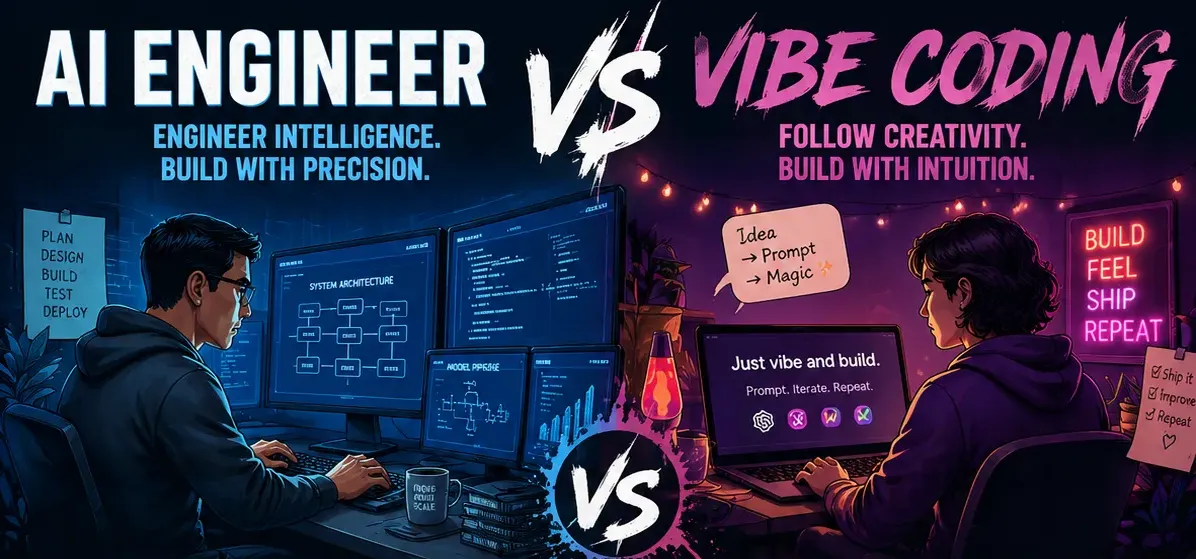
AI Engineering vs Vibe Coding
When deciding how to approach coding or AI projects, it's helpful to understand the differences between AI Engineering and Vibe Coding. Each has its purpose, methods, and best practices.
1. AI Engineering
Purpose:
- Build, deploy, and maintain AI systems for real-world problems.
- Ensure reliability, scalability, and safety in production environments.
Methods:
- Collect, preprocess, and label data.
- Train models using frameworks like PyTorch or TensorFlow.
- Evaluate, tune, and deploy models with MLOps practices.
- Integrate AI into applications and services with APIs or microservices.
Pros:
- High demand and marketable skills.
- Ability to solve large-scale, impactful problems.
- Deep technical learning in mathematics, algorithms, and data science.
Cons:
- Steep learning curve requiring math and statistics knowledge.
- Resource-intensive with computing needs.
- Risk of overengineering if not aligned with business goals.
Tips:
- Focus on solving concrete problems, not just building models.
- Learn Python and AI frameworks thoroughly.
- Understand data pipelines and deployment processes.
- Practice ethical AI principles and bias mitigation.
2. Vibe Coding
Purpose:
- Quickly prototype, experiment, and learn by building.
- Emphasizes creativity and rapid iteration over strict structure.
Methods:
- Dive directly into coding without heavy planning.
- Use frameworks, libraries, or low-code tools to speed development.
- Refactor promising prototypes later.
- Prioritize functional and creative outputs.
Pros:
- Fast results, ideal for hackathons and side projects.
- Encourages creativity and experimentation.
- Low pressure and flexible approach to learning.
Cons:
- Difficult to scale or maintain in production.
- Can result in messy or unreliable code.
- Skipping planning may hide architecture flaws.
Tips:
- Keep experiments isolated in separate repositories or sandboxes.
- Refactor and document projects that evolve into more serious applications.
- Use version control to track changes, even for small experiments.
- Pair this approach with structured learning for balance.
Comparison Table
| Aspect | AI Engineering | Vibe Coding |
|---|---|---|
| Goal | Reliable AI systems in production | Rapid experimentation & prototyping |
| Approach | Methodical, data-driven, tested | Creative, exploratory, flexible |
| Skills Needed | Math, Python, ML frameworks, deployment | General programming, libraries, quick problem solving |
| Pros | High demand, scalable impact | Fast, creative, fun, flexible |
| Cons | Steep learning curve, resource-heavy | Hard to maintain, less scalable |
| Best For | Careers, enterprise AI solutions | Hackathons, side projects, learning |
| Tips | Focus on MLOps, ethics, problem-solving | Isolate experiments, refactor, version control |
💡 Quick Takeaway:
- AI Engineering is structured, disciplined, and long-term oriented.
- Vibe Coding is fast, exploratory, and great for creativity or learning.
Where AI Engineering Meets Vibe Coding
AI Engineering and Vibe Coding can collaborate effectively in projects when their strengths are combined. This usually happens in prototyping, MVPs (Minimum Viable Products), and experimental AI-driven applications.
Best Scenarios to Merge Approaches
Rapid Prototyping of AI Features
- Use Vibe Coding to quickly build a working prototype or interface.
- AI Engineers can plug in real models, optimize pipelines, and ensure the system works under production constraints.
- Example: A chatbot or recommendation system for a startup MVP.
Hackathons & Innovation Sprints
- Vibe Coders iterate fast on ideas.
- AI Engineers validate the feasibility, deploy pre-trained models, or integrate APIs.
- This ensures the solution is both creative and technically sound.
Experimentation Before Scaling
- Start with Vibe Coding to test user interaction, UI/UX, or core logic.
- When the concept proves valuable, AI Engineering takes over to make it robust, efficient, and maintainable.
- Example: An AI-powered photo filter app—prototype quickly, then scale with proper ML pipelines.
AI-Powered Internal Tools
- Vibe Coders can create functional internal dashboards or analytics quickly.
- AI Engineers add real intelligence, like predictive analytics or anomaly detection.
How to Collapse the Middle: Workflow Tips
| Step | Who Leads | Notes |
|---|---|---|
| Ideation & Concept | Both | Brainstorm ideas, decide which parts need AI vs experimentation |
| Prototype / Proof of Concept | Vibe Coding | Focus on speed, UI/UX, and functional demo |
| Model Integration / Validation | AI Engineering | Plug in real models, optimize, ensure scalability |
| User Testing & Feedback | Both | Observe how real users interact; decide if pivot needed |
| Production & Maintenance | AI Engineering | Deploy models, ensure data pipeline reliability, add monitoring |
Tips for a Harmonious Collaboration
- Version Control & Branches: Let Vibe Coders experiment without breaking production-ready code. Merge later once stable.
- Modular Architecture: Separate AI modules from front-end prototypes so both teams can work independently.
- Clear Boundaries: Define what is “experimental” vs “production-ready” early.
- Regular Syncs: Short daily or weekly standups help both sides align on progress and challenges.
- Document Lessons Learned: Vibe Coding experiments often reveal new insights AI Engineers can optimize.